
AnswerDojo Review: Targeted Voice Mock Interviews for Entry-Level Tech Roles
Preparing for entry-level tech interviews presents a distinct hurdle: while computer science and data programs teach core theory, they rarely prepare students to articulate their engineering choices verbally under pressure. Generic AI chatbots can generate sample interview questions, but text-based prompts fail to simulate the real-time pressure of an interviewer probing into technical project architecture. AnswerDojo enters this space as a specialized, voice-driven mock interview platform designed specifically for new graduates pursuing software engineering, data, and product roles.
By pairing conversational voice synthesis and transcription with a database of real job postings and verified candidate interview reports, AnswerDojo attempts to recreate the multi-layered questioning typical of junior technical and behavioral rounds at major tech firms. This review examines AnswerDojo’s technical capabilities, pricing structure, and practical limitations to help you determine if it fits your preparation workflow.
What AnswerDojo Is and How It Actually Works
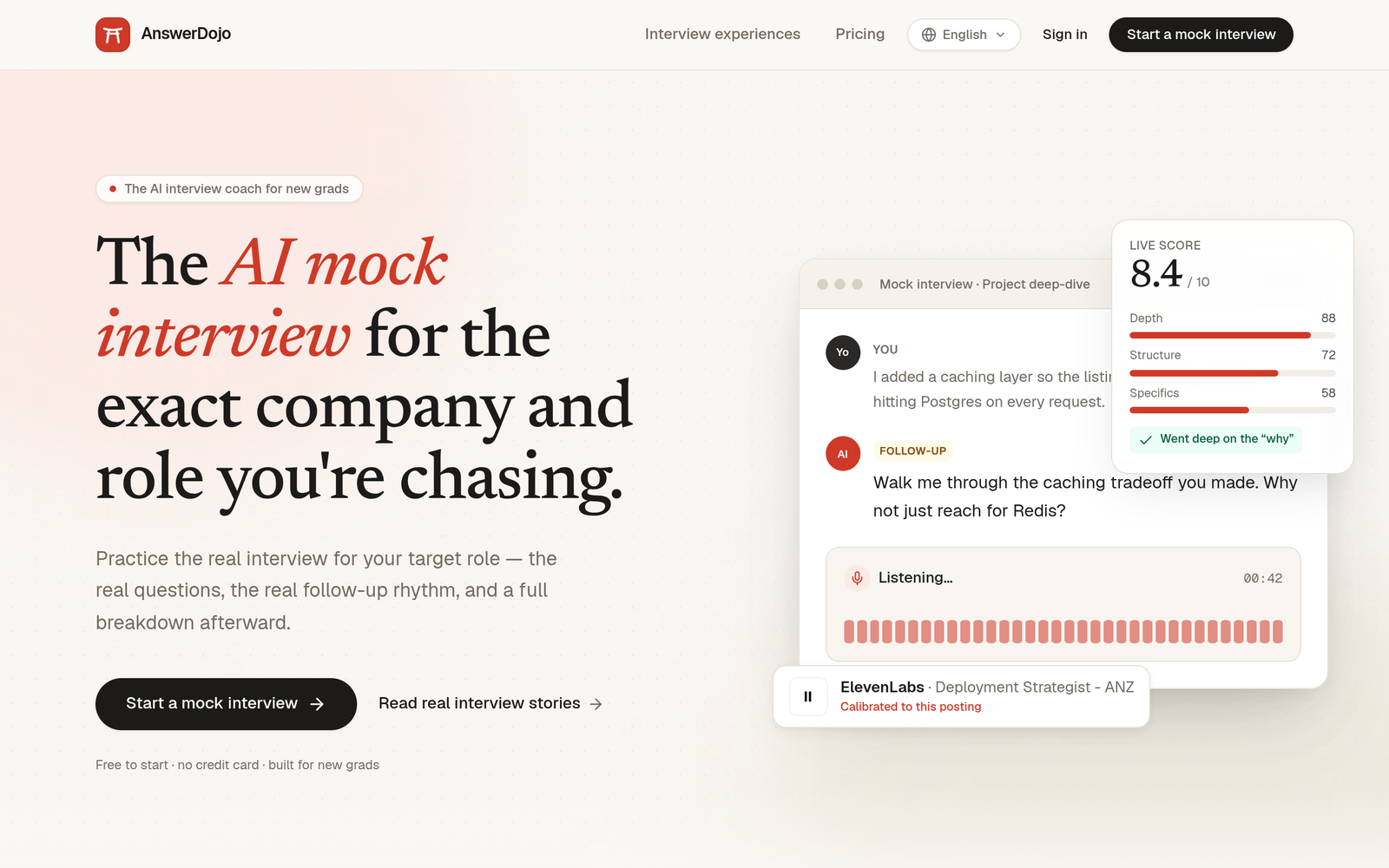
AnswerDojo is an interactive interview simulation tool built around verbal practice rather than text prompts. The platform guides candidates through structured behavioral interviews and technical project deep-dives using an automated conversational loop.
The workflow operates through several connected stages:
- Context Setting: Candidates can select an open position from AnswerDojo’s internal library of job postings, upload an existing PDF or Word résumé, or answer guided questions to build a profile from scratch. The system extracts past projects and claimed technical competencies to establish context.
- Verbal Interaction: An AI interviewer speaks questions aloud. The candidate responds verbally using their microphone. The audio is transcribed in real time so the system can evaluate both the semantic meaning and factual assertions made during the response.
- Dynamic Follow-ups: Instead of advancing through a static list of questions, the engine generates contextual follow-ups. If a candidate mentions optimizing a query or implementing an asynchronous task queue, the AI probes deeper into architectural trade-offs, constraints, and alternative approaches.
- Post-Session Evaluation: Following the interview, the platform generates a score accompanied by focused feedback broken down into structural components such as Depth, Structure, and Specifics.
Target Audience & Ideal Users
AnswerDojo is engineered with specific constraints that suit certain candidates while remaining unsuitable for others. The primary target users include:
- New College Graduates: Candidates targeting entry-level (e.g., L3 at Google, SDE I at Amazon) software engineering, data analytics, and associate product management positions.
- Project Deep-Dive Practice: Candidates who have strong portfolios on paper but struggle when an interviewer asks second- and third-layer technical follow-ups about their design decisions.
- Behavioral Preparation Seekers: Applicants needing structured practice to align their project stories with company-specific behavioral frameworks, such as Amazon’s Leadership Principles.
Core Features & Capabilities
Voice-Based Interactive Sessions
Unlike text-based preparation tools, AnswerDojo relies on verbal delivery. The synthetic interviewer presents questions auditorily, and users speak their answers. The platform transcribes the response to identify key points and dynamically ask realistic follow-ups based on the details provided.
Role and Company Database
The platform maintains an indexed library of 2,247 real job postings across 28 technology companies (including Amazon, Google, and Netflix). This enables the system to tailor question themes and terminology to actual hiring requisites rather than generic question banks.
Interview Experiences Library
AnswerDojo provides a searchable repository containing 64 sourced candidate experiences. These profiles detail the specific interview stages and round-by-round topics reported by candidates who completed entry-level interviews at major tech firms, allowing users to practice the exact sequences they are likely to encounter.
Automated Scoring and Feedback Rubric
After completing an interview session, candidates receive an evaluation report. Performance is graded across several concrete metrics:
- Depth: Evaluates whether the candidate explained the underlying engineering choices or stayed at surface-level summaries.
- Structure: Assesses whether answers follow recognized communication models (such as the STAR method) logically without drifting.
- Specifics: Measures the presence of concrete data, exact technologies, performance metrics, and defined outcomes in the explanation.
Résumé Builder and Story Optimization
For candidates lacking a polished CV, AnswerDojo includes a built-in résumé builder that operates through guided prompts. It also provides a story optimization engine designed to transform raw project summaries into structured narratives paired with likely follow-up questions.
Pricing, Tier Differences, and Plan Limitations
AnswerDojo operates on a freemium model with distinct session limits across its tiers. Voice generation and real-time transcription incur heavy server infrastructure costs, which is reflected in strict usage quotas.
| Plan | Pricing | Voice Mock Quota | Résumé & Story Limits | Key Features Included |
|---|---|---|---|---|
| Free | $0 (Forever) | 2 mock interviews (Lifetime) | 2 résumé builds, 5 story optimizations | Full job posting library, interview guides, no credit card required. |
| 7-Day Sprint | $19 (One-time) | 10 mock interviews (Expires in 7 days) | Unlimited résumé builds & optimizations | Scored evaluations, focused debriefs, designed for short-term cramming. |
| Pro | $99/year (Billed annually) | 20 mock interviews per month | Unlimited résumé builds & optimizations | Year-round practice, continuous feedback, full library access. |
Note: The vendor’s homepage FAQ mentions that “Pro unlocks unlimited practice,” whereas the formal pricing specification explicitly caps Pro tier usage at 20 voice mock interviews per month. Candidates should evaluate their expected volume against this 20-session cap before committing to an annual purchase.
Key Advantages
- Authentic Auditory Friction: Speaking out loud exposes pacing issues, stammering, and conversational gaps that writing in a text box fails to capture.
- Dynamic Follow-Up Logic: By listening and parsing spoken answers, the system challenges vague claims, forcing candidates to explain actual technical implementation details.
- Targeted Junior Context: The platform explicitly tailors its question sets to junior developer and analyst profiles, avoiding the irrelevant executive-level scenarios found in generic interview prep tools.
- Transparent Evaluation Criteria: Breaking feedback down by Depth, Structure, and Specifics provides actionable guidance on where an answer fell short.
- Low-Risk Testing: The free tier includes two full voice mock sessions without requiring payment details upfront.
Documented Drawbacks and Limitations
- Strict Session Caps: The free tier is limited to two lifetime sessions, not two per week or month. Once consumed, further practice requires payment.
- No Real-Time Code Execution: AnswerDojo focuses entirely on behavioral and project architecture discussions. It does not replace live coding environments, LeetCode-style algorithmic evaluators, or interactive technical whiteboard runners.
- Marketing Discrepancy: The discrepancy between the FAQ’s claim of “unlimited practice” and the pricing page’s documented 20 mocks/month on the Pro plan can lead to incorrect expectations regarding high-frequency usage.
- Limited Library Scale: While 2,247 job descriptions is substantial, the candidate experiences library contains 64 records—primarily skewed toward large firms like Amazon and Google. Candidates interviewing at mid-market or boutique firms may find fewer direct role matches.
Who Should Consider AnswerDojo vs. Who Should Look Elsewhere
Consider AnswerDojo If:
- You are a new grad who freezes up or rambles when an interviewer says, “Walk me through the architecture of your capstone project.”
- You have an upcoming behavioral or “hiring manager” screen at a large tech firm and want to rehearse your project stories out loud.
- You need an intensive 7-day refresher ($19) right before an interview loop to calibrate your delivery against targeted questions.
Look Elsewhere If:
- You need an integrated development environment (IDE) to run, compile, and benchmark complex algorithms under time pressure.
- You are a senior-level engineer preparing for high-level distributed systems design interviews involving architecture diagrams.
- You require high-volume, unrestricted voice practice exceeding 20 sessions per month on a continuous basis.
Transparent Editorial Evaluation & Methodology
This review is an independent analysis based on technical product specifications, publicly available vendor documentation, published platform pricing, and verified external research records as of October 2026. aitoolbee.com did not conduct a hands-on audio evaluation for this assessment. All evaluations regarding feature behavior, pricing quotas, and database sizes reflect audited vendor statements and direct platform data points.
Review Methodology & Source Verification
This is a research-based product analysis based on vendor documentation, publicly documented pricing, and verified technical specifications. No hands-on trial was conducted.
Last Verified: October 17, 2026
Primary Sources: AnswerDojo Official Documentation
Similar AI Tools You Might Like

Advelum is an AI ad generator that turns product photos, text prompts, or visual references into...

MrScraper is an AI-powered visual web scraping and API platform that converts websites into structured data...

WisdomPlan is an AI-powered, community-driven learning platform designed to help adult learners achieve skill mastery and...