
Quick Executive Summary
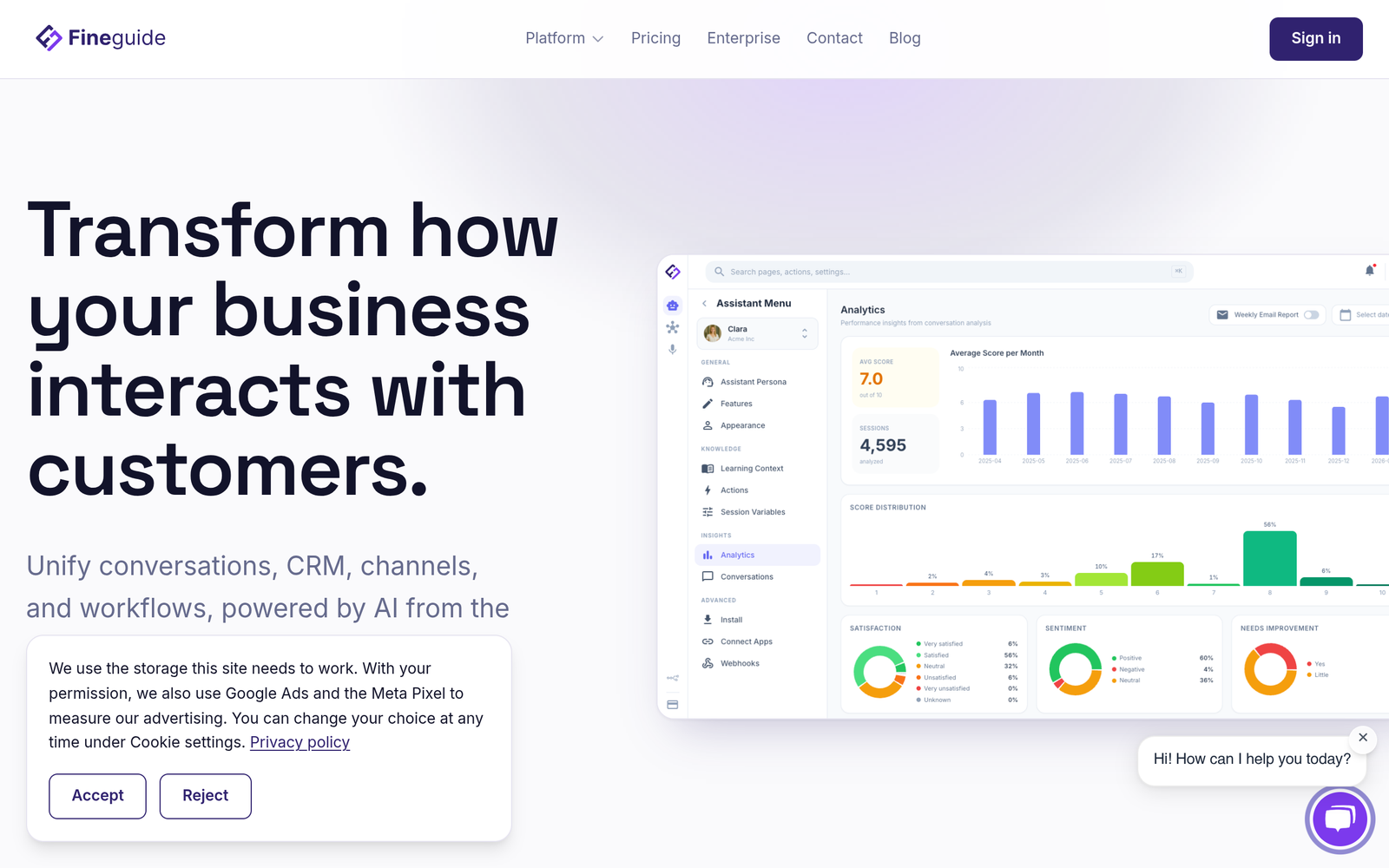
Modern customer operations typically require running three to five distinct SaaS products: a customer relationship management (CRM) database, an omnichannel support inbox, a telephony provider, an automated quality assurance (QA) auditing tool, and a workflow automation engine. Fineguide approaches this problem by unifying these disjointed layers into a single AI-native operational platform. It combines conversational AI across seven messaging channels, inbound and outbound SIP telephony, automated voice call scoring, an internal CRM, and deep workflow automation powered by embedded or self-hosted n8n.
This Fineguide review breaks down the platform’s technical capabilities, verified pricing model, unit economics, and operational tradeoffs. While Fineguide offers immense utility by not charging credits for CRM access or standard inbox actions, its consumption-based credit system—specifically for voice synthesis and Voice QA—carries strict rollover restrictions that demand precise capacity planning.
What Fineguide Is and How It Actually Works
Fineguide is an end-to-end customer operations platform designed to orchestrate both automated and human interactions across text and voice channels. Rather than acting as a simple chatbot layer sitting on top of external software, Fineguide provides its own foundational infrastructure.
The system operates across five core technical pillars:
- Knowledge Ingestion: Fineguide ingests structured and unstructured data from website URLs, raw documents, and PDFs into a central knowledge base. This context powers conversational agents across text and telephony.
- Omnichannel Routing: Inbound text interactions from Web chat, WhatsApp, Telegram, Instagram, Messenger, Slack, and Discord flow into a centralized Team Inbox that also supports standard IMAP/SMTP email protocols.
- Telephony & Voice Quality Assurance: Through SIP integrations, the platform handles inbound voice routing and executes outbound automated calling campaigns. Simultaneously, an automated Voice QA engine transcribes audio and scores conversations against department-specific grading criteria.
- Native CRM & Workspace: Contact records, pipelines, tasks, and company data are managed natively via Kanban boards and table views. A built-in block editor featuring slash commands and full-text search serves as an internal documentation hub.
- Visual Workflow Automation: Fineguide includes an automation builder with condition branching and record looping, integrated directly with n8n (supporting both embedded and bring-your-own-instance setups) to manipulate data and execute operational triggers.
Target Audience & Ideal Users
Fineguide is built primarily for teams managing high-touch communications across multiple modalities who want to escape SaaS fragmentation:
- Customer Support Centers: Teams looking to deflect routine inquiries on web and messaging apps while unifying email ticketing and telephone support in one view.
- Call Centers & Telephony Teams: Operations requiring automated outbound campaigns alongside systematic QA audits on 100% of recorded calls without manual spot-checking.
- Mid-Sized Sales Operations: Sales units that need pipeline management, outbound dialers, and automated lead qualification without maintaining costly parallel subscriptions for telephony, CRM, and workflow middleware.
- Customer Success Teams: Account managers needing unified timelines of customer emails, voice calls, tasks, and shared documentation within a single contact record.
Core Features & Capabilities
Multi-Channel AI Assistants
Fineguide deploys conversational assistants across seven standard messaging endpoints: Web, WhatsApp, Telegram, Instagram, Messenger, Slack, and Discord. The vendor reports conversational response latencies under two seconds across connected channels, with language support spanning over 30 languages for text conversations and audio transcriptions.
AI Telephony & Voice QA
The platform connects to existing telecommunication backbones via SIP protocol. It supports inbound call handling, automated interactive outbound calling campaigns, and post-call analysis. Voice QA automatically transcribes calls and evaluates them against customized, department-level criteria, outputting quantitative scores directly into the conversation history.
Built-In CRM & Team Inbox
The integrated CRM includes customizable pipelines, lifecycle stages, Kanban views, tabular views, task assignments, and multi-entity company records. The Team Inbox connects via standard IMAP/SMTP credentials, allowing human agents to co-manage shared mailboxes, apply rule-based message routing, and seamlessly switch between automated AI deflection and human takeover.
Visual Workflows & Document Workspace
Workflow automation extends beyond simple linear triggers; Fineguide incorporates conditional branching, record looping, and native integration with n8n (both hosted internally or connected via external BYO n8n setups). In addition, teams can maintain internal standard operating procedures and documentation via a block-based editor featuring slash-command shortcuts and indexed search.
Pricing, Tier Differences, and Plan Limitations
Fineguide operates on a freemium pricing structure billed in Euros (EUR), although reference prices are shown in USD. Unlike platforms that charge seat licenses for basic database usage, Fineguide does not consume credits for CRM records, team inboxes, basic messaging, workflows, or reporting.
| Plan | Monthly Price (Billed Yearly) | Included Monthly Credits | Included Team Seats | Knowledge Base Limit |
|---|---|---|---|---|
| Free | €0/mo forever | 200 (One-time only) | Owner + 1 Teammate (2 total) | 1M characters (~200 docs) |
| Starter | €100/mo (€80/mo) | 3,000 / month | Owner + 3 Teammates (4 total) | 5M characters |
| Business | €200/mo (€160/mo) | 8,000 / month | Owner + 5 Teammates (6 total) | 10M characters |
| Premium | €500/mo (€400/mo) | 25,000 / month | Owner + 10 Teammates (11 total) | 20M characters |
| Enterprise | Custom quote | Custom packages | Custom allocation | Custom allocation |
Credit Consumption Metrics & Operational Constraints
Understanding how credits are burned is critical to evaluating the real cost of Fineguide:
- Standard AI Reply: 1 credit per generation (increases to 2–3 credits for multi-action or multi-step reasoning responses).
- AI Phone Calls: 10 credits per minute on the standard voice engine; 30 credits per minute on the premium engine.
- Voice QA: 12 credits per minute of processed audio, subject to a 1-minute minimum per call.
- Credit Expiration: Credits do not roll over from month to month. Any unused monthly balance is forfeited at the end of the billing cycle.
- Plan Changes: Unused purchased credits do not transfer if an account cancels or changes tiers.
- Free Plan Limitations: The Free tier receives 200 credits once upon registration; these credits do not refresh monthly. Additional seat purchases are disabled on the Free tier.
Key Advantages
- True Tech Stack Consolidation: Consolidating telephony, automated call QA, omnichannel ticketing, and CRM eliminates the need for expensive third-party integration pipelines (e.g., connecting Aircall to Gong, Intercom, and HubSpot).
- Zero-Cost CRM & Workflow Operations: Core data layer utilities—including viewing CRM records, moving pipeline cards, routing inbox tickets, and running internal workflow triggers—do not burn usage credits.
- Open Automation Architecture: The integration with n8n (including support for connecting an external, self-hosted n8n instance) offers deep flexibility that avoids vendor lock-in for complex automations.
- Flexible Enterprise Hosting: Enterprise tiers support self-hosted deployments across bare metal, private clusters, or private cloud environments for organizations with strict compliance mandates.
Documented Drawbacks and Limitations
- Restrictive Rollover Policy: Monthly credits operate on a strict “use-it-or-lose-it” policy. If call volumes or chat inquiries fluctuate seasonally, unused credits cannot be banked for peak periods.
- Rapid Credit Burn on Voice Operations: At 12 credits per minute for Voice QA and up to 30 credits per minute for premium AI calling, a team on the Starter tier (3,000 credits) would exhaust their entire monthly credit pool in just 100 minutes of premium phone calls or 250 minutes of Voice QA, leaving zero credits for chat replies.
- Misleading Free Tier: Because the Free plan provides only a one-time grant of 200 credits that never renews, it serves as an initial sandbox trial rather than a sustainable freemium tier for ongoing automated operations.
- Seat Scalability Caps: The Starter and Business plans include relatively low fixed seat allocations (4 and 6 total seats, respectively), which may force growing support teams into higher pricing tiers purely for agent access.
Who Should Consider Fineguide vs. Who Should Look Elsewhere
Consider Fineguide if:
- You run a blended customer support and sales operation that relies heavily on text messaging channels (WhatsApp, Instagram, Telegram) alongside voice telephony.
- You want an integrated Voice QA system that automatically reviews inbound/outbound calls without having to license enterprise-grade speech analytics software.
- You want to leverage complex n8n workflows directly tied to customer interaction events and pipeline stages.
Look elsewhere if:
- You already have an entrenched CRM ecosystem (e.g., mature Salesforce or HubSpot enterprise deployments) and only require a standalone AI chat widget.
- Your operations handle high-volume outbound calling with tight margins; the credit burn rate for telephony and Voice QA will quickly push you into expensive tiers.
- You are looking for a genuine, perpetually free tier to handle ongoing automated customer queries.
Transparent Editorial Evaluation & Methodology
This technical evaluation of Fineguide is a research-based product analysis conducted by AI Tool Bee. Our assessment relies strictly on verified platform documentation, publicly disclosed technical specifications, verified credit consumption rules, and formal pricing documentation. No hands-on testing was conducted for this review. Performance attributes—including the sub-two-second latency benchmarks, 30+ language coverage, and enterprise bare-metal hosting availability—are recorded as reported by the vendor.
Review Methodology & Source Verification
This is a research-based product analysis based on vendor documentation, publicly documented pricing, and verified technical specifications. No hands-on trial was conducted.
Last Verified: October 16, 2026
Primary Sources: Fineguide Official Documentation
Similar AI Tools You Might Like
QuickBot AI is a chatbot and AI-powered tool that uses natural language processing (NLP) to understand...