
Quick Executive Summary
Producing variations of video advertising typically demands expensive reshoots or tedious multi-layer rotoscoping in post-production. Genjutsu addresses this operational bottleneck as an AI video-to-video editing platform that alters characters, backgrounds, props, weather, and aesthetic styles from single-take video clips while preserving the original camera path, pacing, and motion. With an entry pricing point of $19 per month ($15.83 per month billed annually) and multi-model access across all tiers, it offers performance marketers and AI creators a direct way to iterate on short-form assets. However, strict input requirements—mandating single-take clips between 4 and 30 seconds—and a consumption rate of 15 credits per second make deliberate project planning essential to avoid rapid credit depletion.
What Genjutsu Is and How It Actually Works
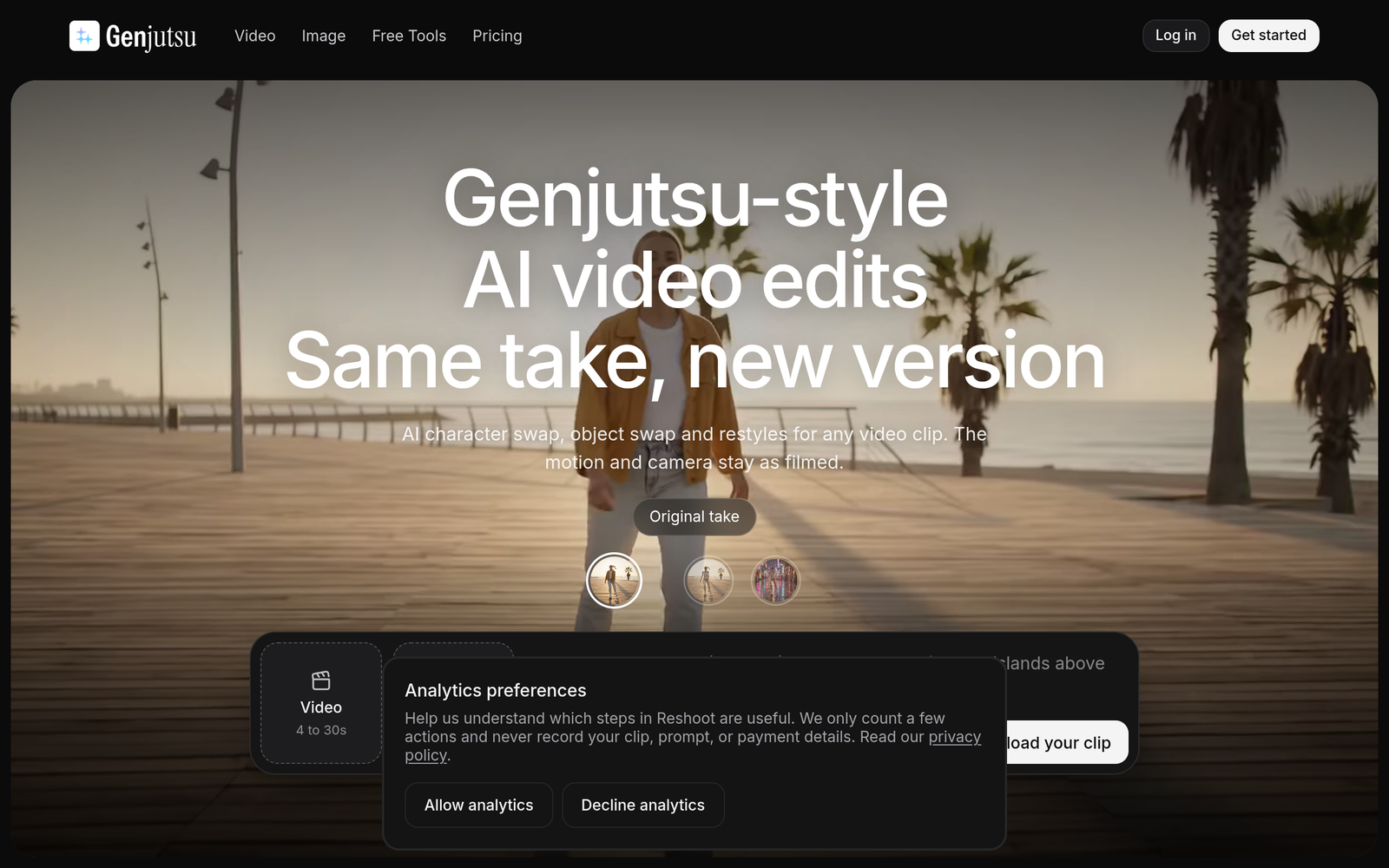
Genjutsu is a web-based video-to-video synthesis engine designed to modify visual elements within existing video footage without losing the physics, framing, or timing of the source recording. It operates differently from standard text-to-video tools, which generate entirely unconstrained scenes from scratch, often resulting in drifting cameras and unpredictable subject movement.
To use the platform, users upload a single-take video clip between 4 and 30 seconds in length. The system does not support pre-edited clips containing jump cuts or scene transitions, as sudden cuts disrupt the underlying motion tracking. Once the footage is uploaded, creators input descriptive text prompts detailing what to replace—such as changing an actor’s appearance, swapping a desk prop, altering weather conditions, or transforming the environment. Creators can also upload an optional reference photo to guide specific character designs or aesthetic cues.
According to vendor documentation, Genjutsu routes processing across multiple leading video generation architectures on the same subscription, listing support for Seedance 2.0, Sora 2, Kling 3.0, Veo 3.1, and Runway Gen-4.5. Note that Genjutsu is an independent product operated via genjutsu.si and is neither affiliated with nor endorsed by Higgsfield, which maintains a separate product sharing a similar naming convention.
Target Audience & Ideal Users
Genjutsu is tailored for creative operators who prioritize rapid iteration on existing visual pacing over open-ended text-to-video prompting:
- User-Generated Content (UGC) Advertisers: Media buyers can shoot an actor delivering a single continuous hook, then generate variations featuring different actors, wardrobe styles, and room backdrops to identify winning ad creatives without scheduling additional production shoots.
- AI Influencer Creators: Developers managing synthetic personas can capture real-world movement in continuous short takes and map their stored digital avatars onto those movements consistently.
- Global Marketing Teams: Localization specialists can adapt a single commercial take across multiple geographic regions by updating the cast demographics and environmental aesthetics while preserving synchronized voiceover pacing and camera motion.
- Creative Agencies: Teams working on visual restyles can refresh legacy campaign footage using the system’s eight built-in restyle presets to explore fresh art directions.
Core Features & Capabilities
Based on verified product documentation, Genjutsu includes the following key features across its platform:
- Motion and Path Preservation: Edits adhere directly to the movement vectors, camera trajectories, and temporal timing of the source video, preventing the typical spatial warping common in text-only generation.
- Prompt-Driven Element Swapping: Users can isolate and describe changes for people, environments, objects, atmospheric conditions, or overall artistic styles, reinforced with optional image references.
- Unlimited Saved Personas: Every plan allows creators to save reusable digital characters indefinitely, ensuring recurring identity consistency across different video batches.
- Integrated Studio Editor: Rather than forcing immediate roundtrips to external video editors, the built-in studio interface enables basic timeline trimming, caption generation, and background music integration prior to final file export.
- Interactive Comparison Tools: An on-canvas, drag-to-compare split-screen slider lets editors inspect frame-by-frame structural parity between the source video and the generated output.
- Transparent Credit Calculation: The user interface displays the exact credit calculation prior to running any generation job, eliminating guesswork around project costs.
Pricing, Tier Differences, and Plan Limitations
Genjutsu uses a credit-based freemium pricing structure. While the vendor references access to free tools, explicit allocations for a persistent free tier are not defined in the public documentation. Paid plans grant full access to all supported underlying video models, unlimited persona slots, the built-in studio editor, and commercial distribution rights.
Video rendering carries a standardized cost of 15 credits per second regardless of the output resolution. Fractional clip runtimes are prorated and rounded up to the nearest whole credit. Under this pricing rule, processing a standard 10-second clip consumes 150 credits.
| Plan | Monthly Cost | Annual Cost (Monthly Equivalent) | Included Monthly Allowances | Effective Video Output |
|---|---|---|---|---|
| Entry | $19.00 / mo | $15.83 / mo ($190 billed yearly) | 1,300 credits per month | ~86 total seconds of processed video / mo |
| Pro | $40.83 / mo | $40.83 / mo ($490 billed yearly) | 2,600 rollover credits, 650 AI images, 4 hours AI voiceover | ~173 total seconds of processed video / mo |
Paid subscriptions include a 3-day refund policy, providing a brief window to test generation output against your specific footage requirements before fully committing.
Key Advantages
- Deterministic Motion Control: By locking generation directly to real camera movements, Genjutsu bypasses the frame jitter, phantom limbs, and erratic camera sweeps typical of purely generative text-to-video workflows.
- Multi-Model Redundancy: Consolidating models like Seedance 2.0, Sora 2, Kling 3.0, Veo 3.1, and Runway Gen-4.5 under a single subscription prevents the financial overhead of maintaining multiple standalone platform accounts.
- No Tiered Gatekeeping on Utility: Essential commercial rights, the studio editor, and unlimited persona libraries are provided from the baseline Entry tier rather than locked behind enterprise-level paywalls.
- Predictable Compute Costs: The fixed 15 credits-per-second fee model makes operational costs upfront and straightforward to forecast when planning monthly creative testing budgets.
Documented Drawbacks and Limitations
- Strict Clip Structuring Constraints: Footage must be a continuous single take between 4 and 30 seconds. Attempting to run pre-edited sequences with cuts confuses the motion analysis, rendering the tool ineffective for processing finished timelines.
- Limited Output Volume on Entry Tier: At 1,300 credits per month, the $19 Entry tier yields roughly 86 seconds of processed footage. Creators running iterative trials may exhaust their monthly quota across just eight or nine 10-second tests.
- Short Refund Evaluation Window: The 3-day refund window requires teams to immediately test the platform’s suitability for their assets upon subscription activation.
- Market Name Confusion: Because another video tool operates under the Higgsfield Genjutsu brand, buyers must take care to verify that the specifications, features, and pricing reviewed here correspond to this standalone platform (genjutsu.si).
Who Should Consider Genjutsu vs. Who Should Look Elsewhere
Consider Genjutsu if:
- You run direct-response UGC campaigns and need to test different actors, hooks, and localized backgrounds while keeping pacing, vocal cadence, and camera movements intact.
- You manage synthetic brand ambassadors and need a dependable way to project your custom personas into real-world physical actions.
- You want an integrated workflow that includes light timeline adjustments, caption generation, and music additions without immediately jumping into separate editing suites.
Look elsewhere if:
- You require long-form generative synthesis or need to process complex multi-shot edits and sequence cuts within a single pipeline.
- You need unprompted, fully original concept generation from scratch without providing existing reference footage.
- You run high-volume generation workflows on a strict budget, where a consumption cap of 86 seconds per month on the entry plan creates an immediate cost barrier.
Transparent Editorial Evaluation & Methodology
This technical analysis of Genjutsu is an editorial product review derived entirely from publicly accessible technical specifications, verified functional claims, and published commercial pricing from the vendor’s domain as of late 2026. No hands-on testing or synthetic benchmarking was executed for this profile. Features categorized as “vendor-reported” reflect operational claims published directly by the tool’s developers that await independent laboratory validation.
Review Methodology & Source Verification
This is a research-based product analysis based on vendor documentation, publicly documented pricing, and verified technical specifications. No hands-on trial was conducted.
Last Verified: October 16, 2026
Primary Sources: Genjutsu Official Documentation
Similar AI Tools You Might Like

ContentEdge is a powerful copywriting and SEO tool that harnesses the power of AI to generate...

Durable is an all-in-one solution that empowers users to create and run their own website building...

Zoocial is an all-in-one digital marketing automation tool that enables businesses to take their social media...