Quick Executive Summary
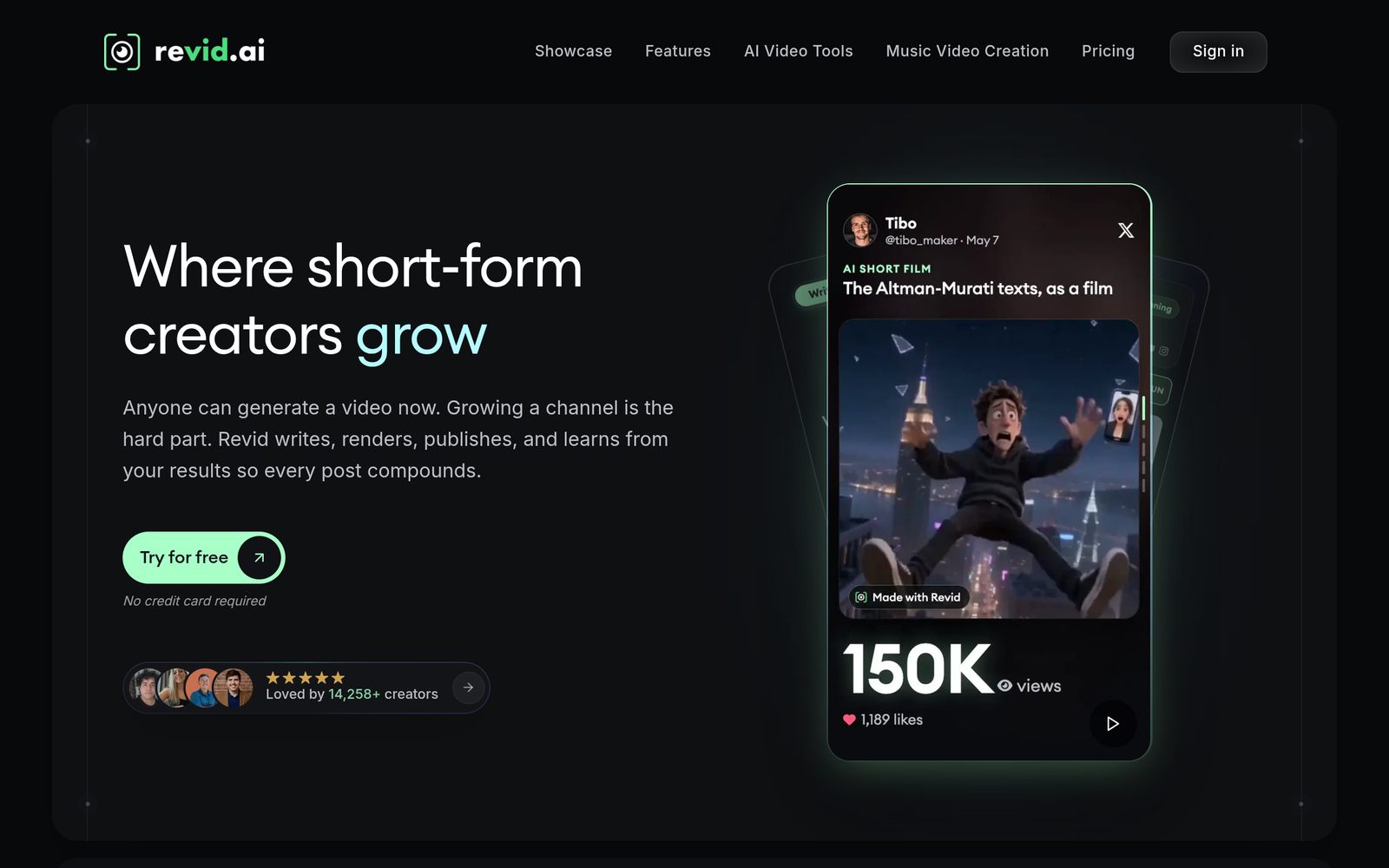
Producing consistent, high-volume video content across vertical platforms like TikTok, YouTube Shorts, and Instagram Reels often stalls at the editing and asset-assembly stage. Typeframes (also operating in parts of its ecosystem as Revid AI) tackles this bottleneck by automating video production directly from raw inputs such as text prompts, documents, audio tracks, and web links. By bundling automated scripting, synthetic voiceovers, dynamic captions, and an integrated timeline editor, the platform enables creators and digital teams to bypass manual timeline assembly. While it offers deep developer integrations (including an API, CLI, and MCP support) and a zero-commitment trial, buyers should be mindful of limited public documentation regarding render caps across its subscription tiers.
What Typeframes Is and How It Actually Works
Typeframes is a cloud-based automated video creation platform designed to convert varied media formats into structured, ready-to-publish video assets. Rather than requiring users to manually slice clips, align audio waveforms, and transcribe subtitles in a traditional non-linear editor (NLE), Typeframes relies on an AI-assisted generative pipeline.
The operational workflow generally follows these sequential stages:
- Asset Ingestion: Users supply an initial asset, which can be an idea prompt, an uploaded PDF document, a pre-recorded audio track or podcast snippet, an image, or a live product URL.
- Structure & Script Generation: The platform analyzes the core material to draft a narrative or promotional script, breaking the content down into logical video scenes.
- Voice and Visual Synthesis: Typeframes pairs the script with synthetic voiceovers (with reported localization support across 32 languages) and generates synchronized visual cues, animations, or sound-reactive elements.
- Timeline Customization: Through an internal web-based editor, users can override automated choices by adjusting scene timings, rephrasing scripts, changing visual elements, and tweaking caption aesthetics.
- Export & Syndication: Completed videos can be exported locally or pushed directly to vertical video channels, including TikTok, Instagram Reels, and YouTube Shorts.
Target Audience & Ideal Users
Typeframes is optimized for users whose primary objective is velocity and high-cadence publishing rather than frame-by-frame visual effects composition. Key user segments include:
- SaaS Founders & Product Marketers: Teams needing to generate concise explainer assets, changelog videos, and feature launch clips directly from documentation or URLs.
- Short-Form Content Creators: Publishers producing viral skits, facts, and commentary for TikTok, Instagram Reels, and YouTube Shorts.
- Independent Artists & Audio Producers: Creators looking to produce sound-reactive visualizers or music videos synchronized to imported audio files or Spotify links.
- Publishers & Educators: Teams repurposing existing text repositories, whitepapers, or podcast recordings into animated vertical summaries.
Core Features & Capabilities
Based on verified product documentation and platform data, Typeframes incorporates several specialized creative modules:
| Feature Module | Technical Capability |
|---|---|
| Multi-Modal Ingestion | Includes dedicated modules for Prompt-to-Video, PDF-to-Video, Audio-to-Video, and Image-to-Video conversion pipelines. |
| Voiceover & Subtitle Engine | Automated voice synthesis paired with auto-generated, kinetic subtitle animations across a vendor-reported library of 32 languages. |
| AI Music Video Visualizer | Generates sound-reactive visual components that synchronize transitions and graphic effects to the beat of an imported audio track. |
| Viral Structure Intelligence | Search and ideation engine designed to analyze high-performing video formats to assist in script structuring. |
| Browser-Based Studio | A lightweight timeline editor that allows manual revision of voiceover text, timing offsets, and asset placements. |
| Developer & Workflow Tooling | Provides access to automation pipelines, an API, Model Context Protocol (MCP) integrations, and a command-line interface (CLI) for automated video rendering pipelines. |
Pricing, Tier Differences, and Plan Limitations
Typeframes employs a freemium acquisition model designed to minimize initial onboarding friction:
- Free Tier / Evaluation: Prospective users can evaluate the tool via a “Try for free” option that does not require entering a credit card upfront.
- Paid Tiers: Third-party industry reporting indicates that paid subscriptions start at approximately $29 per month when billed on an annual cycle.
- Pricing Transparency Issues: The vendor does not explicitly outline exhaustive tier-by-tier credit allowances, render limits, or export resolution thresholds directly on its primary public landing page. Teams requiring rigid SLA guarantees or high-volume enterprise rendering will need to inspect the dashboard or consult sales to verify render ceilings.
Key Advantages
- Broad Format Repurposing: The ability to feed in audio files, PDFs, or raw URLs makes it versatile for teams sitting on vast catalogs of underutilized text and audio.
- Developer-Centric Integrations: The inclusion of an API, CLI, and MCP support is rare in consumer-focused AI video tools, allowing engineering teams to automate video output programmatically.
- Low Barrier to Entry: Offering free access without demanding payment details upfront lets creators test visual fidelity before committing budget.
- Specialized Sound-Reactive Tools: The dedicated music video generator provides an accessible path for musicians to create engaging visualizers without specialized 3D or motion graphics software.
Documented Drawbacks and Limitations
- Opaque Tier Quotas: Prospective buyers must navigate into the tool to uncover detailed restrictions regarding monthly rendering limits, watermark policies, and concurrent rendering allowances.
- Template Uniformity Risk: AI-generated layouts and kinetic typography can feel formulaic if the user does not take advantage of the custom editor to inject brand-specific visual assets.
- Unsuitable for Deep Post-Production: Typeframes is not a replacement for high-end digital audio workstations (DAWs) or complex non-linear video editors. It lacks multi-track node compositing, advanced color grading, and complex masking capabilities.
Who Should Consider Typeframes vs. Who Should Look Elsewhere
Who Should Consider Typeframes
- Solo founders and social media growth teams needing to ship multiple vertical clips daily across TikTok and YouTube Shorts.
- Developers seeking to build programmatic video pipelines using an API or CLI.
- Indie musicians and podcasters seeking automated visuals to accompany audio snippets.
Who Should Look Elsewhere
- Commercial filmmakers or post-production teams that require precise control over camera motion, fine-grained keyframing, and multi-layer optical compositing.
- Procurement departments that require fully transparent, publicly accessible pricing grids and strict data compliance terms before creating an account.
Transparent Editorial Evaluation & Methodology
This technical analysis of Typeframes is an editorial, research-based product review conducted by evaluating vendor technical documentation, third-party pricing aggregates, and verified functional claims. No independent hands-on software benchmarking or stress testing was performed for this assessment. Performance claims—such as the processing of over 100,000 monthly renders and support across 32 languages—reflect vendor-reported metrics recorded during our product analysis.
Review Methodology & Source Verification
This is a research-based product analysis based on vendor documentation, publicly documented pricing, and verified technical specifications. No hands-on trial was conducted.
Last Verified: October 19, 2026
Primary Sources: Typeframes Official Documentation