
Quick Executive Summary
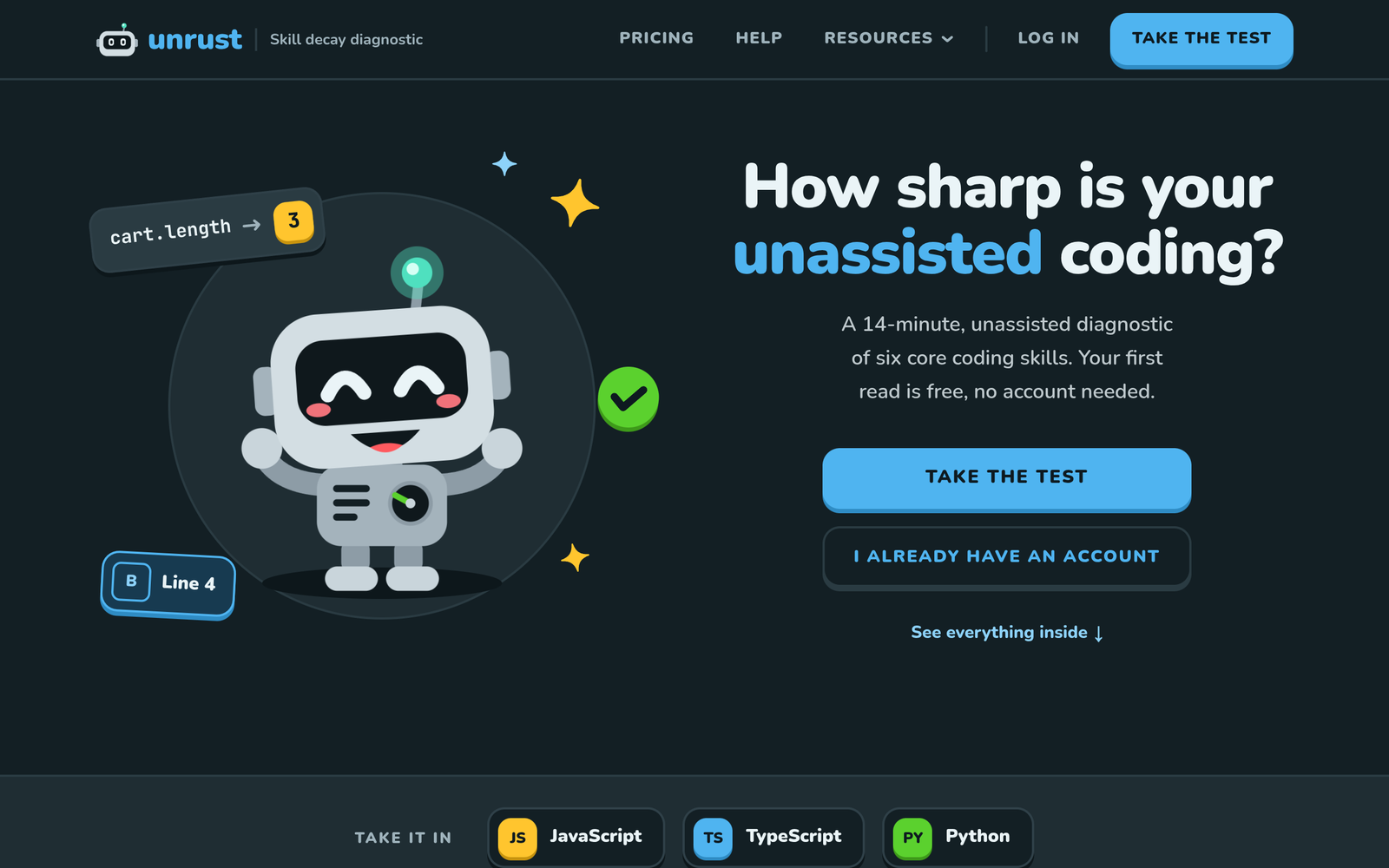
As modern engineering environments increasingly incorporate autocomplete and generative code tools, developers face a distinct risk: the silent atrophy of foundational coding mechanics. Unrust (unrust.dev) directly targets this skill decay. It is a browser-based diagnostic and adaptive practice platform that assesses raw, unassisted programming capabilities in JavaScript, TypeScript, and Python. Stripping away auto-complete, language servers, and AI assistants, Unrust evaluates an engineer’s core abilities across six dimensions—ranging from variable state tracing to detecting flawed AI-generated code—in a structured 14-minute benchmark.
While its training mechanics, line-by-line trace replays, and confidence calibration metrics offer clear utility for interview preparation and skill retention, Unrust operates with an unconventional constraint: all paid access requires non-recurring cryptocurrency payments (USDT, USDC, or DAI on Ethereum). This review analyzes Unrust’s features, diagnostic framework, practical tradeoffs, and target user profile.
What Unrust Is and How It Actually Works
Unrust is an automated diagnostic and habit-building system engineered to measure how well a developer understands and writes code without editor crutches. The platform rejects traditional LeetCode-style algorithmic puzzles in favor of testing everyday code literacy, syntax fluency, and execution modeling.
The core entry point is a 14-minute timed diagnostic offered across JavaScript, TypeScript, or Python. During this test, external aids are disabled. Rather than just grading binary passes or fails, Unrust measures how an engineer reasons about code across six core proficiencies:
- Recall: Writing idiomatic syntax and core APIs from memory.
- Debugging: Identifying and isolating active defects within given snippets.
- Find the Flaw: Spotting subtle logic errors before running code.
- Tracing: Accurately tracking variable state mutations line by line.
- Idiom/Quality: Differentiating between clumsy workarounds and clean language idioms.
- AI-slop Detection: Evaluating code that appears syntactically plausible at a glance but contains subtle hallucinated behavior, anti-patterns, or logic traps.
Following the diagnostic, Unrust plots the user’s performance alongside a “Sure vs. Measured” confidence graph. This contrasts self-reported certainty against actual performance, exposing dangerous blind spots where an engineer assumes they are correct but actually made an error. A line-by-line trace replay tool allows the user to step through the execution path of failed problems to observe variable states step by step.
Target Audience & Ideal Users
Unrust is specifically structured for technical professionals who need to maintain raw coding fluency:
- Engineers Preparing for Technical Screenings: Candidates facing live coding rounds, unassisted paired programming interviews, or whiteboard assessments where Copilot and IDE autocompletion are prohibited.
- Mid and Senior Developers Experiencing Skill Atrophy: Programmers who rely heavily on AI generation and want a quantitative checkup to verify their core language recall and debugging intuition are intact.
- Code Reviewers and Tech Leads: Engineers responsible for auditing pull requests who need sharpened code-reading and error-spotting reflexes, particularly for evaluating AI-drafted contributions.
Core Features & Capabilities
Based on verified product documentation, Unrust builds on its initial diagnostic with daily drills and longitudinal tracking tools.
1. “Today’s Forge” Adaptive Queue
Once a user establishes an account, the platform generates a daily queue called “Today’s Forge.” This queue is algorithmically tuned to serve challenges targeting the user’s lowest-scoring categories from their diagnostic profile. Free accounts receive one Forge session per day, while paid tiers allow unlimited queues.
2. The Mastery Ladder & Skill-Decay Tracking
To quantify retention over weeks and months, Unrust sorts skills into four dynamic states: Cold, Warming, Solid, and Sharp. Inactive periods or inaccurate drills cause skills to regress down the ladder, giving developers a visual representation of language rust. Paid tiers retain long-term skill-decay trend charts broken down by individual language tracks.
3. 7-Day Interview Pre-Flight Program
Designed for immediate pre-interview conditioning, this module packages focused workouts and timed dry runs. It forces engineers to practice rapid unassisted debugging and line tracing under clock pressure to simulate unassisted interview environments.
4. Daily Code-Reading Puzzle (Unrust #N) & Habit Mechanics
Beyond the adaptive queue, Unrust hosts an open daily code-reading puzzle that tests fast comprehension. To support daily practice without burnout, the system incorporates habit tracking with XP, forge streaks, configurable built-in rest days, and options to customize or tone down gamification and celebration graphics.
Pricing, Tier Differences, and Plan Limitations
Unrust utilizes a freemium pricing architecture. However, its payment mechanics deviate significantly from industry standards: the platform rejects traditional recurring credit card billing, requiring all paid plans to be funded via single, prepaid cryptocurrency transactions on the Ethereum blockchain.
| Plan | Pricing Model | Core Entitlements | Key Limitations |
|---|---|---|---|
| Free (No Account) | $0 | 14-minute diagnostic, 6-skill breakdown, sure vs. measured read, trace replay tool, daily puzzle (Unrust #N). | No history tracking; results are ephemeral to the browser session. |
| Free (With Account) | $0 | All non-account features plus 1 adaptive queue per day (Today’s Forge), historical diagnostic records, and habit tracking (XP, streaks, rest days). | Capped at 1 practice queue per day; no historical skill-decay trend charts or full drill library access. |
| Monthly Flex | $4.99 for first 30 days, then $10.99 per 30-day block | Unlimited adaptive queues, complete drill library, full mastery ladder tracking, saved skill-decay trend charts, and 7-day interview pre-flight mode. | Prepaid only; no auto-renewal. Requires payment via USDT, USDC, or DAI on Ethereum. |
| Annual Rebuild | $84 for 365 days | All Monthly Flex features across the full year. | Single upfront payment in supported ERC-20 stablecoins; no auto-renewal. |
Key Advantages
- Calibration via Sure vs. Measured Metrics: Measuring confidence against correctness directly tackles the issue of overconfidence in software development, pinpointing where developers hold false assumptions about language mechanics.
- First-Class “AI-Slop” Testing: Unrust is among the few developer training tools that explicitly tests a developer’s ability to spot flawed or subtly broken AI-generated syntax.
- Friction-Free Diagnostic: Developers can take the full 14-minute diagnostic across JavaScript, TypeScript, or Python without entering payment credentials or creating an account.
- No Zombie Subscriptions: The prepaid crypto billing model guarantees users will never experience accidental recurring credit card charges after completing an interview preparation cycle.
Documented Drawbacks and Limitations
- Restrictive Payment Infrastructure: Payments must be made using ERC-20 stablecoins (USDT, USDC, or DAI) on the Ethereum mainnet. Developers without Web3 wallets, or those relying on corporate credit cards for professional development stipends, will find paid access difficult or impossible to expense.
- Narrow Language Support: The platform is restricted to JavaScript, TypeScript, and Python. Systems developers, backend engineers working in Go, Rust, Java, or C++, and mobile engineers have no coverage.
- Single Daily Drill on Free Account: Users unwilling or unable to transact on Ethereum are hard-capped at one adaptive Forge queue per day, limiting Unrust’s utility as a high-volume drill platform for free users.
Who Should Consider Unrust vs. Who Should Look Elsewhere
Consider Unrust If:
- You rely heavily on tools like GitHub Copilot or Claude and want an objective metric of whether your raw language recall and tracing skills are deteriorating.
- You have upcoming live coding interviews that enforce pure browser environments without language-server auto-completions.
- You are comfortable making stablecoin transactions on Ethereum to unlock uncapped daily practice drills.
Look Elsewhere If:
- You are preparing for FAANG-style competitive programming or complex data structure/algorithm rounds that require deep dynamic programming and graph theory practice (platforms like LeetCode or NeetCode remain standard for this).
- Your primary programming stacks are outside of JavaScript, TypeScript, or Python.
- Your employer requires standard corporate credit card invoicing or vendor procurement workflows for reimbursement.
Transparent Editorial Evaluation & Methodology
This review is an independent analysis grounded in public technical documentation, verified pricing specifications, and product features published by Unrust as of mid-October 2026. Aitoolbee.com did not conduct hands-on interactive test flights for this profile. Ratings and evaluations reflect documented system behavior, explicit constraint declarations, and functional comparisons against industry-standard developer training tools. If you represent the platform and wish to report updates to language availability or payment infrastructure, please contact our editorial staff.
Review Methodology & Source Verification
This is a research-based product analysis based on vendor documentation, publicly documented pricing, and verified technical specifications. No hands-on trial was conducted.
Last Verified: October 16, 2026
Primary Sources: Unrust Official Documentation
Similar AI Tools You Might Like
If you're a developer, you know how important code reviews are for ensuring that your code...
Bito is a powerful AI-powered assistant for developers that can help them write better code faster....
Code-GPT is a powerful extension for Visual Studio Code that uses artificial intelligence to provide instant...