Quick Executive Summary
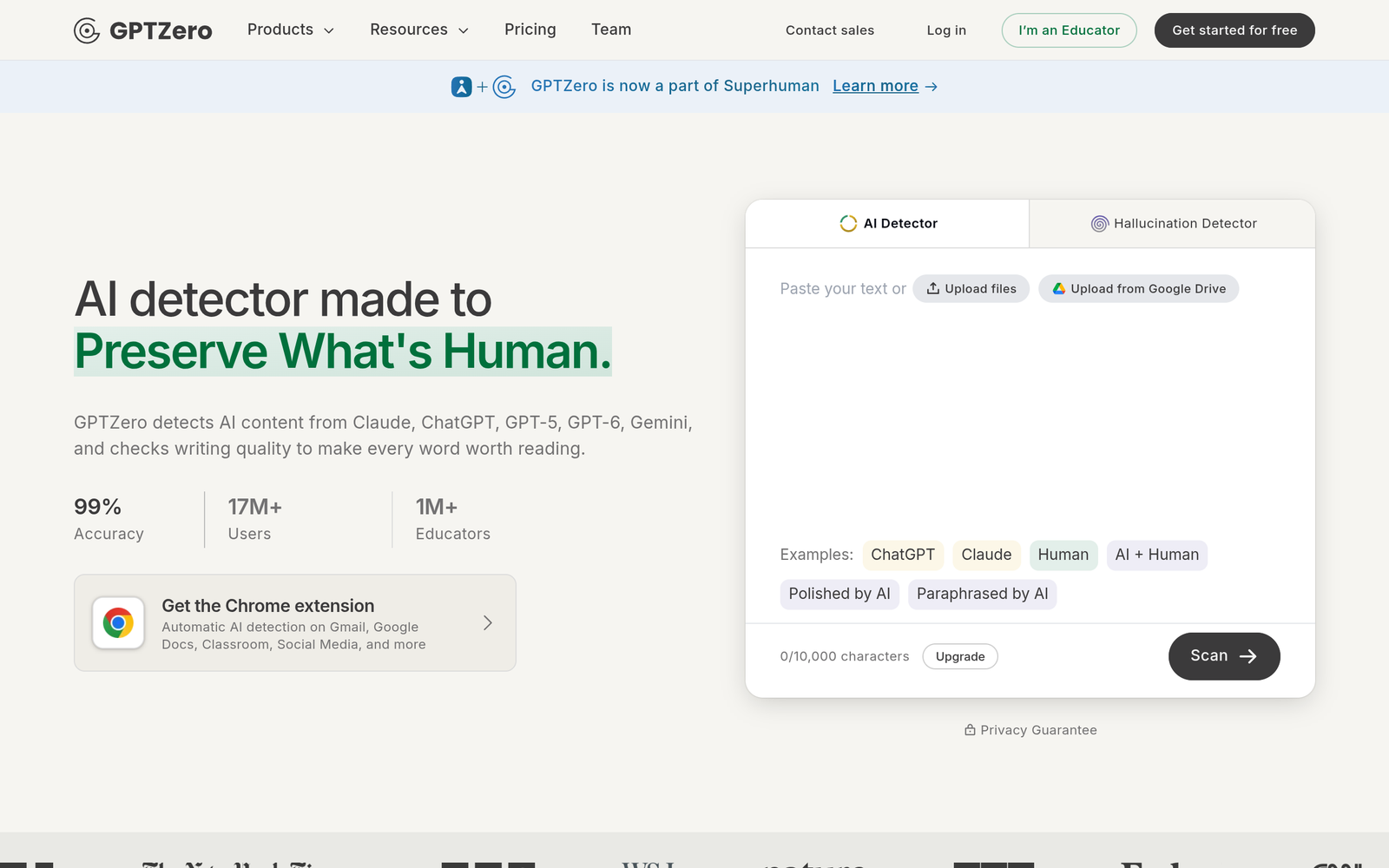
The widespread adoption of generative artificial intelligence has introduced a difficult challenge for publishers, academic institutions, and employers: distinguishing authentic human composition from automated machine output. GPTZero is an AI content analysis and text verification platform engineered to detect text produced by models such as ChatGPT, Claude, Gemini, and Llama, while providing tools to document and verify human authorship.
| Attribute | Specification |
|---|---|
| Core Function | Multi-model AI text detection, plagiarism scanning, and authorship verification |
| Supported LLM Targets | OpenAI (ChatGPT/GPT-4), Anthropic (Claude), Google (Gemini), Meta (Llama) |
| Key Verification Mechanism | Statistical text classification (perplexity/burstiness) plus behavioral Writing Replay |
| Pricing Architecture | Freemium; tiered individual subscriptions, team plans, and API credits |
| Compliance Standards | SOC 2 Type II, FERPA, GDPR, CCPA |
What GPTZero Is and How It Actually Works
Understanding what is GPTZero requires examining the statistical mechanics of machine-generated text. Large language models operate on probabilistic token prediction, generating sentences that maximize statistical plausibility. Consequently, purely AI-generated text exhibits uniform predictability and rhythmic consistency across paragraphs.
GPTZero analyzes submitted prose through two primary statistical lenses:
- Perplexity: A metric measuring how unexpected a sequence of words is to a language model. Human writing frequently introduces non-standard phrasing, idioms, and irregular syntax, generating higher perplexity scores. AI models typically generate lower perplexity scores because they favor high-probability word sequences.
- Burstiness: A metric evaluating variance in sentence length, structure, and complexity. Human writers naturally alternate between short, punchy statements and convoluted compound clauses. In contrast, language models tend to maintain uniform sentence cadence across longer passages.
Beyond passive text scanning, GPTZero has introduced behavioral auditing. Rather than relying solely on statistical inferences from static text—which can yield false positives—the platform includes features like Writing Replay to inspect the human writing process over time, tracking revisions, active typing sessions, and bulk copy-paste actions directly within editing environments.
Target Audience & Ideal Users
GPTZero serves environments where textual provenance carries institutional, academic, or professional liability:
- Higher Education & K-12 Educators: Instructors requiring systematic auditing of student essays, research submissions, and take-home exams, backed by integrations into standard Learning Management Systems (LMS).
- Publishers & Editorial Desks: Media outlets and content marketing agencies protecting search index reputation and editorial guidelines by screening freelance submissions for undisclosed machine generation.
- Recruiting & Admissions Teams: Evaluators reviewing candidate cover letters, technical prompts, and application statements for baseline authenticity.
- Students & Independent Writers: Authors seeking defensive documentation to establish proof of independent authorship prior to final submission.
Core Features & Capabilities
Multi-LLM Detection Engine
The platform trains its classifiers against evolving outputs from leading foundational model providers, including OpenAI, Anthropic, Google, and open-source weights such as Meta’s Llama series. This broad coverage prevents detection gaps caused by cross-model prompting strategies.
Writing Replay & Behavioral Proof
Statistical detection alone can be contested. GPTZero addresses this through a proprietary Google Docs integration that records keystroke behavior, time elapsed, and editing sequences. If an author is accused of using automated tools, the platform provides video-style playback of the composition process, differentiating continuous typing from abrupt external paste events.
Plagiarism & Hallucination Detection
Alongside AI attribution scanning, GPTZero includes a conventional plagiarism engine that compares scanned text against open web indices and academic databases. Additionally, its Hallucination Detector cross-references citations, assertions, and factual claims against underlying source documents to flag fabricated references commonly produced by LLMs.
Enterprise Integrations & Infrastructure
GPTZero connects with academic and developer ecosystems through dedicated extensions and native software connections:
- Learning Management Systems: Native hooks for Canvas and Google Classroom.
- Productivity Interfaces: Chrome extension and Google Docs add-on.
- Workflow Automation & API: Zapier integration and direct REST API endpoints for high-volume automated batch scanning.
- Data Privacy: Certified compliance with SOC 2 Type II, FERPA, GDPR, and CCPA standards, ensuring submitted text is processed in accordance with institutional data governance protocols.
Pricing, Tier Differences, and Plan Limitations
GPTZero operates on a freemium pricing structure split across single-seat, collaborative team, and programmatic API access.
| Plan Tier | Estimated Pricing | Word / Character Allowance | Primary Capabilities |
|---|---|---|---|
| Free Tier | $0 | 10,000 characters per scan | Basic web-interface detection, access to free Chrome & Google Docs extensions |
| Individual Plan | Reported ~$14.99/mo (or $9.99/mo billed annually) | Expanded monthly word allocations | Sentence-by-sentence breakdown, AI writing feedback, Hallucination checks |
| Professional Team | Tiered per seat (min. 2–3 seats) | 500,000 words per member / month | Shared organizational credits, centralized billing, multi-file batch scanning |
| Developer API | Usage-based pricing | Metered volume access | Programmatic endpoint queries, continuous pipeline integration |
Note on pricing accuracy: The 500,000 word-per-member team plan quota is verified via vendor documentation. Individual plan pricing ($9.99 to $14.99 per month) is widely reported in vendor marketing materials but remains unverified across promotional cycles. Check GPTZero’s direct pricing page for current promotional adjustments.
Key Advantages
- Dual-Layer Attribution: GPTZero pairs post-hoc statistical parsing with real-time keystroke tracking (Writing Replay), offering a defensible audit trail rather than just an opaque percentage score.
- Rigorous Institutional Compliance: Achieving SOC 2 Type II, FERPA, and GDPR adherence makes it viable for deployment in district-level academic settings and regulated corporate legal departments.
- Third-Party Benchmark Validation: According to vendor-reported data from the independent RAID benchmark, GPTZero achieved a 95.7% detection rate against machine text alongside a low 1% false positive rate on human text.
- Educational Ecosystem Alignment: Direct integration with Canvas, Google Classroom, and Google Docs minimizes workflow disruption for educators grading large cohorts.
Documented Drawbacks and Limitations
- Probabilistic Nature of Statistical Detection: Despite reported detection claims (including a vendor-claimed 99% baseline accuracy), no statistical classifier is infallible. Nuanced human writing—especially from non-native English speakers who rely on standard sentence structures—can trigger elevated AI attribution scores.
- Strict Free-Tier Caps: The web-based free tier is restricted to 10,000 characters per scan, limiting users scanning comprehensive theses, multi-chapter manuscripts, or large technical dossiers without an upgrade.
- The LLM “Cat-and-Mouse” Reality: As foundational models introduce advanced reasoning steps, varied sentence structures, and humanization wrappers, AI detection algorithms must continuously retrain their classifiers to avoid performance drift over time.
- False Confidence in Punitive Scenarios: Relying exclusively on an AI detection percentage to penalize students or terminate contractors presents ethical and administrative risks. The tool should be treated as an investigative signal rather than definitive legal proof.
Who Should Consider GPTZero vs. Who Should Look Elsewhere
Recommended For:
- Academic Faculties: Teachers and professors who need integrated Canvas/Google Classroom workflows and want behavioral writing replays to resolve suspected academic dishonesty equitably.
- High-Volume Editorial Operations: Content agencies and digital publications that require batch scanning and automated Zapier pipelines to prevent AI-generated submissions from entering their publishing pipelines.
- Authors and Freelancers: Professionals who want an incontrovertible, step-by-step record of their manual drafting process to protect their reputations against unverified AI allegations.
Not Recommended For:
- Zero-Tolerance Disciplinary Authorities: Administrators looking for a single, indisputable binary metric to automate punitive actions without conducting human reviews.
- Offline Environments: Organizations operating within air-gapped environments or secure local enclaves, as GPTZero requires active cloud connectivity for token and model evaluation.
Transparent Editorial Evaluation & Methodology
This technical evaluation is an independent, research-based product analysis conducted by AI Tool Bee. Findings are derived from verified technical documentation, public compliance disclosures, vendor-reported benchmark audits (such as the RAID benchmark dataset), and architectural specifications published by GPTZero. No compensated engagement or hands-on clinical lab testing was conducted for this specific update. Feature availability and subscription tiers should be verified against vendor systems prior to large-scale institutional procurement.
Review Methodology & Source Verification
This is a research-based product analysis based on vendor documentation, publicly documented pricing, and verified technical specifications. No hands-on trial was conducted.
Last Verified: October 18, 2026
Primary Sources: GPTZero Official Documentation