Quick Executive Summary
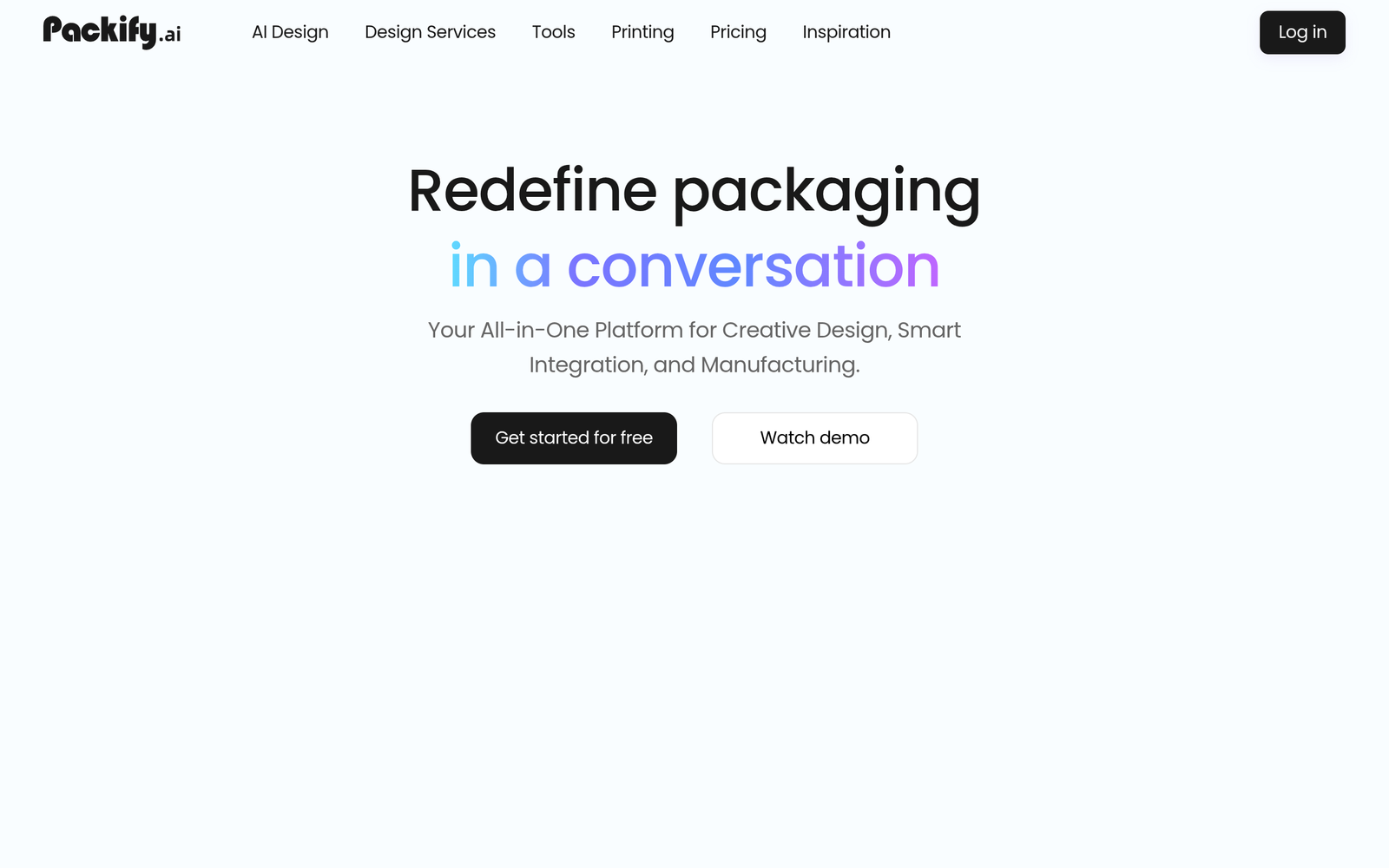
Physical packaging design has traditionally been fragmented into two distinct workflows: 3D concept visualization handled by branding designers and mechanical dieline creation handled by structural packaging engineers. Packify.ai positions itself as a unified AI packaging agent designed to bridge this divide. The platform converts text prompts into 3D packaging mockups, generates print-ready vector dielines, and automates marketing asset creation via AI photoshoots and label generators.
While Packify.ai provides an integrated pipeline from conceptual rendering to vector specification export, prospective buyers should navigate its credit-based model carefully. The free tier offers 100 non-refreshing credits—effectively enough for 10 design operations—and base subscription pricing is not publicly disclosed in standard platform documentation. For fast-moving consumer goods (FMCG) startups, e-commerce brands, and agency designers needing rapid structural prototyping, it offers a functional alternative to manual CAD and render staging, provided users account for the platform’s credit burn rates.
What Packify.ai Is and How It Actually Works
Packify.ai is a specialized generative design platform tailored specifically for packaging production. Generalist image generators like Midjourney or DALL-E produce raster images of boxes or bottles that lack geometric accuracy, unflattened layout plans, and print specifications. Packify.ai addresses this limitation by coupling visual generation with structural packaging logic.
The operational workflow inside Packify.ai follows a step-by-step pipeline:
- Text-to-3D Concept Generation: Users input text prompts detailing the packaging style, material expectations, form factor, and brand aesthetic. The system generates a three-dimensional packaging concept that can be viewed and rotated within an integrated Mockup Studio.
- Design Editing and Asset Application: Designers can upload brand logos, adjust color schemes, and integrate custom typography directly onto the 3D surface using the smart design editor.
- Regulatory and Information Layering: The platform includes dedicated utilities to generate custom product labels and formatted nutrition facts panels directly onto the package artwork.
- Dieline Extraction: Rather than leaving the user with an isolated 3D mockup, the platform generates a flattened, manufacturable dieline exportable in vector formats, detailing fold lines, cut lines, and bleed margins ready for prepress.
- Marketing Asset Staging: Through its AI Photoshoot feature, users can isolate the finished packaging model and swap backgrounds to create contextual commercial photography for e-commerce listings.
Target Audience & Ideal Users
Packify.ai is engineered for teams and individuals involved in physical product launches where turnaround speed and visual experimentation are paramount:
- FMCG and E-commerce Brands: Direct-to-consumer (DTC) brands that iterate quickly across multiple SKUs and need digital mockups for consumer testing before placing factory orders.
- Independent Packaging Designers and Agencies: Creative professionals looking to accelerate initial client pitching by producing both photorealistic 3D concepts and initial mechanical dielines in a single pass.
- Early-Stage Hardware and Food/Beverage Startups: Small teams without in-house industrial packaging engineers who need production-ready vector specifications and regulatory labels (such as nutrition facts).
- E-commerce Operations Teams: Organizations seeking programmatic generation of product packaging and render variations via Packify.ai’s API.
Core Features & Capabilities
Packify.ai’s utility is anchored in several verified core features designed for packaging-specific pipelines:
Text-to-3D Packaging Generation and Mockup Studio
Users can generate 3D packaging models directly from natural language prompts. The built-in Mockup Studio allows real-time previewing, enabling teams to evaluate lighting, surface texture, and structural geometry before committing to layout files.
Print-Ready Dieline Generation and Vector Export
The system automatically converts 3D packaging designs into two-dimensional, flattened dielines. These files can be exported as vector assets, including standard structural markings (cut lines, perforations, and score lines) required by commercial packaging manufacturers.
Smart Design Editing and Logo Integration
The editor allows users to map their own vector and raster assets onto the generated packaging. Brand logos, color palettes, and graphic elements can be positioned directly on the 3D form, with the software mapping them accurately across both the 3D model and the flattened dieline.
Custom Label and Nutrition Facts Creator
Packify.ai includes specialized modules for food, beverage, and supplement packaging. Users can construct standardized nutrition facts tables and compliance-oriented label layouts without having to draft them manually in third-party desktop publishing tools.
AI Photoshoot (Background Swapping)
For marketing teams, the AI Photoshoot utility removes the generated 3D package from its default staging environment and places it into realistic lifestyle, studio, or contextual backgrounds for marketing collateral and digital storefronts.
Team Collaboration and API Access
Higher-tier accounts support shared Brand Kits, centralized team credit pools, and additional seats. For engineering and operations teams, Packify.ai provides API access to automate packaging generation within existing product information management (PIM) or e-commerce workflows.
Pricing, Tier Differences, and Plan Limitations
Packify.ai operates on a freemium model governed by a strict operational credit system. Understanding credit consumption is critical for estimating total cost of ownership.
| Plan Tier | Target User | Licensing & Seats | Key Inclusions & Credit Rules |
|---|---|---|---|
| Free Trial | Evaluation only | Non-commercial / Single user | 100 one-time credits; credits do not refresh. Access to core features. |
| Pro | Individual professionals | Personal commercial license; 1 seat | Monthly resetting subscription credits (base price not publicly listed in source documentation). |
| Business | Growing brands & agencies | Company commercial license; expandable seats | Includes API access, shared Brand Kits, and shared team credits. Additional seats cost $9.90/month per seat (base plan price not disclosed). |
| Enterprise | Large organizations | Custom corporate license; includes 4 seats by default (Owner + 3 members) | Full team access, expanded management controls, dedicated support (pricing custom/undisclosed). |
Credit Consumption and Expiration Rules
- AI Design / Edit Operations: Each generation or modification in the AI Editor consumes 10 credits per operation.
- AI Photoshoot Operations: Swapping or generating backgrounds costs 5 credits per image.
- Trial Restrictions: The 100 free credits allow approximately 10 AI edits or 20 photoshoot generations. Once depleted, the free tier does not reset.
- Subscription Expiration: Subscription-allotted credits reset monthly and do not roll over to the next billing cycle.
- Top-Up Expiration: Credits purchased via add-on top-up packs remain valid for 12 months from the purchase date before expiring.
Key Advantages
- Integrated Dieline Pipeline: Unlike standard generative AI engines that produce flat 2D raster art, Packify.ai bridges conceptual ideation and physical manufacturing by outputting vector-based dielines.
- Purpose-Built Packaging Modules: Native tools for creating nutrition facts panels and custom labels eliminate the need to switch back and forth between CAD, vector illustration, and typography software for routine packaging tasks.
- Automated E-commerce Staging: The AI Photoshoot tool allows direct generation of marketing lifestyle imagery straight from the design phase, reducing reliance on physical prototyping sessions.
- Scalable Integration: The availability of an API alongside Business and Enterprise plans makes programmatic packaging generation possible for large product catalogs.
- Collaborative Workspaces: Business and Enterprise plans support Brand Kit sharing, helping distributed teams maintain brand consistency across different packaging concepts.
Documented Drawbacks and Limitations
- Opaque Base Subscription Pricing: While the cost for additional team seats on the Business plan ($9.90/month) is publicly specified, the baseline subscription prices for Pro, Business, and Enterprise plans are not disclosed upfront in standard documentation, requiring users to navigate into the platform or contact sales to determine baseline software costs.
- Strictly Limited Free Tier: Because the 100 free credits are one-time only and do not refresh, the platform cannot be used as a recurring free tool. A user running complex iterations can exhaust the free allowance within minutes (10 edit operations).
- Use-It-or-Lose-It Subscription Credits: Monthly plan credits do not roll over. If your team experiences low design output in a given month, paid credits vanish at the billing cycle reset.
- Physical Proofing Still Required: While Packify.ai generates manufacturable dielines, software-generated vector cut-lines cannot account for unique substrate thicknesses, corrugated fluting variations, or specific folding machine tolerances without validation by an experienced structural designer or print house.
- Unverified Vendor Metrics: Vendor marketing materials claim “over 200,000 brands and designers worldwide” and “10x faster time-to-market with 90% lower design and sampling costs.” These figures reflect vendor-reported marketing assertions rather than independent third-party benchmarks.
Who Should Consider Packify.ai vs. Who Should Look Elsewhere
Consider Packify.ai If:
- You are a DTC or FMCG brand that needs to rapidly visualize, test, and render new physical product concepts without hiring a CAD agency for early-stage ideation.
- You are a freelance packaging designer seeking to provide clients with both photorealistic 3D mockups and foundational vector dielines in a fraction of the time.
- You manage an e-commerce catalog requiring consistent background swaps and digital staging across dozens of packaging variations.
Look Elsewhere If:
- You require fully transparent, self-serve, flat-rate pricing without credit burn calculations or monthly expiration limits.
- You are engineering high-tolerance, multi-component industrial packaging (e.g., custom molded pulp inserts, complex rigid luxury boxes with internal electronics) where specialized CAD software (like ArtiosCAD) and manual structural engineering are mandatory.
- You are looking for an ongoing free mockup tool; Packify.ai’s free allowance is strictly an evaluation trial.
Transparent Editorial Evaluation & Methodology
This review of Packify.ai is an objective, research-based technical analysis. Findings are derived from an examination of Packify.ai’s official technical documentation, published terms, verified platform credit costs, and direct pricing disclosures recorded as of October 2026. No hands-on software trial was conducted for this evaluation; performance claims related to speed improvements and cost reductions are attributed to vendor disclosures and noted accordingly. AI Tool Bee maintains strict editorial independence and does not accept compensation for favorable software assessments.
Review Methodology & Source Verification
This is a research-based product analysis based on vendor documentation, publicly documented pricing, and verified technical specifications. No hands-on trial was conducted.
Last Verified: October 18, 2026
Primary Sources: Packify.ai Official Documentation