Quick Executive Summary
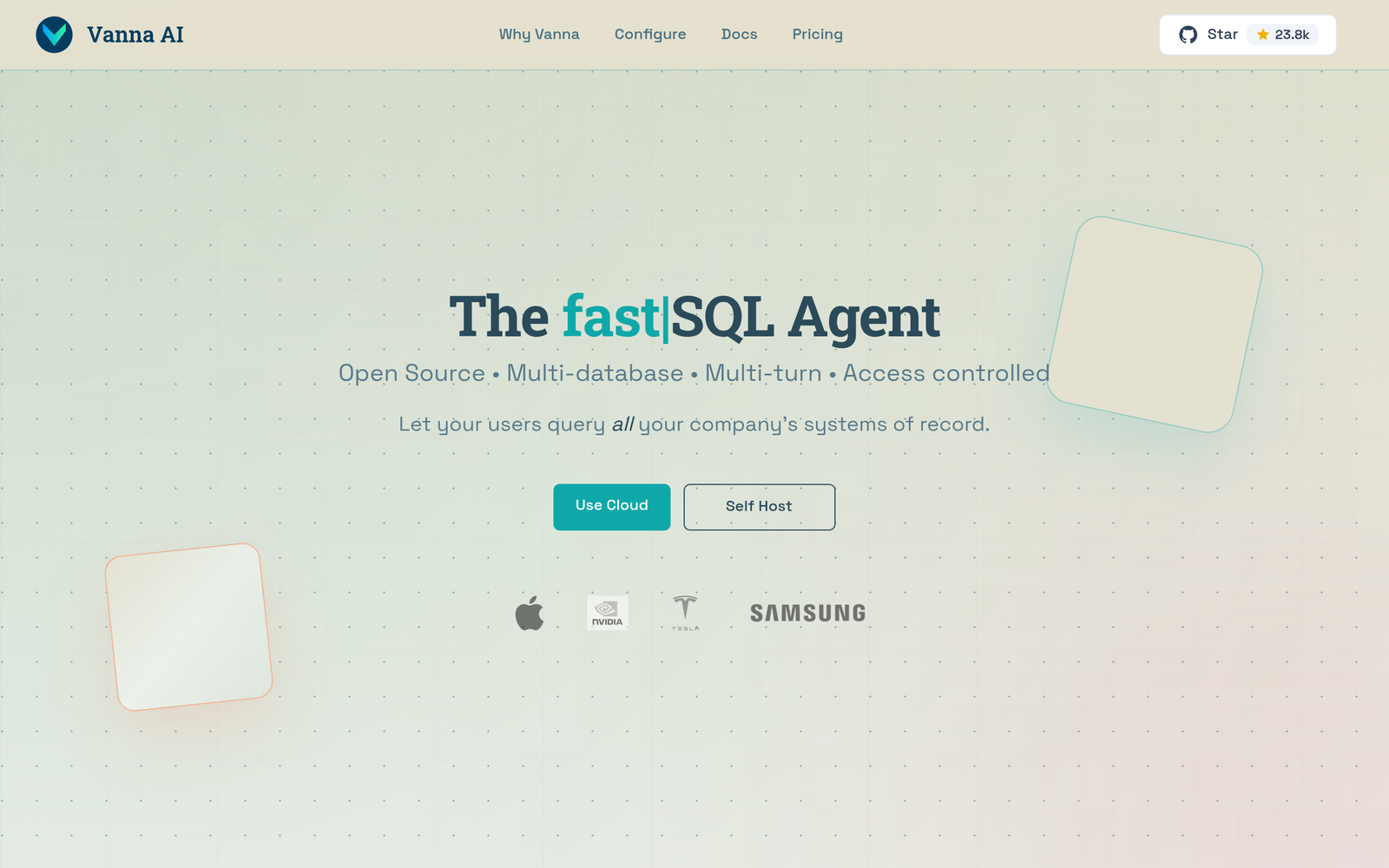
Vanna AI is an open-source, multi-database SQL agent designed to translate natural language questions into executable database queries. Rather than locking users into a proprietary artificial intelligence model or an unchangeable backend, Vanna operates as a modular framework available via Python package installation (pip install vanna) alongside hosted commercial offerings. It bridges relational data stores—such as PostgreSQL, MySQL, SQLite, Snowflake, and Google BigQuery—with popular language models from OpenAI, Anthropic, Google (Gemini), and local open-source runtimes via Ollama.
While the open-source core provides developers with the autonomy to build self-hosted Text-to-SQL pipelines without software licensing costs, the commercial managed plans introduce governance, storage, and administrative features. However, prospective users should evaluate query throttling constraints on entry-level commercial tiers, where daily question quotas can limit organizational deployment without advancing to enterprise contracts.
What Vanna AI Is and How It Actually Works
Writing reliable SQL requires a deep understanding of database schema design, table relationships, and dialect-specific syntax. When business teams need fast answers, data engineering and analytics teams frequently become bottlenecks. Vanna AI functions as an intermediate abstraction layer that parses plain-language prompts into syntactically valid database queries, executes them against configured data sources, and supports continuous conversational refinement.
At a functional level, Vanna AI operates through the following mechanics:
- RAG-Driven Context Gathering: Instead of sending raw database records to large language models, Vanna collects relevant schema definitions, documentation, and historical reference queries. This metadata is embedded within a vector database (agent memory) to generate accurate context for the prompt.
- Model Orchestration: The gathered contextual schema and the user’s plain-language request are sent to a selected LLM provider (such as Anthropic Claude, OpenAI GPT, Google Gemini, or a self-hosted model via Ollama) to synthesize the appropriate SQL dialect.
- Query Execution & Conversational Refinement: The resulting query interacts directly with the connected data warehouse or database. Because Vanna supports multi-turn conversational querying, users can ask follow-up questions to filter, aggregate, or recalculate results without starting a new query session from scratch.
Target Audience & Ideal Users
Vanna AI serves both technical implementers and non-technical consumers within an organization:
- Software and Data Engineers: Technical builders who need a customizable, scriptable Python framework to embed conversational data retrieval directly into custom dashboards, internal tools, or client applications.
- Data Analysts: Technical specialists looking to eliminate repetitive ad-hoc querying requests from cross-functional teams by exposing an automated conversational agent connected to verified schemas.
- Non-Technical Business Stakeholders: Product managers, operations leads, and executives who need direct, natural language access to company metrics without learning complex SQL joins or waiting on analytical ticket queues.
- Enterprise Data Teams: Organizations needing multi-database flexibility alongside strict governance, requiring audit logs, role-based access control, and self-hosted or on-premises deployment options.
Core Features & Capabilities
Vanna AI differentiates itself by decoupling the SQL generation framework from specific infrastructure providers. Key technical capabilities include:
- Multi-Database Support: Out-of-the-box compatibility with local and production databases, including SQLite, PostgreSQL, and MySQL, as well as enterprise cloud warehouses such as Snowflake and Google BigQuery.
- LLM Provider Flexibility: Freedom to toggle between third-party hosted commercial APIs (Anthropic, OpenAI, Google Gemini) and fully localized, private models hosted internally through Ollama.
- Open-Source Core Framework: Distributed openly as a standard Python library (
vanna), allowing developers to build, modify, and host their custom Text-to-SQL logic on their own computing infrastructure at zero software licensing cost. - Agent Memory & Metadata Storage: Built-in vector database integration that maintains context across schemas, past queries, and data definitions, refining code generation over time.
- Multi-Turn Conversational Interface: The ability to track context across an interactive exchange, enabling iterative data drill-downs without respecifying base table conditions.
- Enterprise Admin & Governance Tools: Available through the commercial managed service, including access controls, audit logs, file system access, data retention settings, and operational observability.
Pricing, Tier Differences, and Plan Limitations
Vanna AI operates under a freemium pricing structure, ranging from an open-source self-hosted baseline to managed multi-user plans. Annual commitments across all paid tiers receive a 20% discount.
| Plan | Price | Daily Question Limits | Key Features & Governance | Support Level |
|---|---|---|---|---|
| Vanna OSS (Free) | $0 (Free) | Self-managed / Unlimited by software | Full access to the core Python framework, modular model/DB connections, self-hosted deployment. | Community-driven |
| Explorer | $50 / month | 20 questions / day | API access, admin features in Vanna OSS or Cloud, agent memory, file system, audit logs (for 2–3 users). | Same-day email support |
| Team | $500 / month | 300 questions / day | All Explorer features, broader team scale, administrative onboarding assistance. | Same-day live support |
| Enterprise | Custom quote | Unlimited questions | On-premises deployment support, SAML SSO, dedicated admin API, advanced custom integrations. | Dedicated enterprise support |
A critical consideration on the paid plans involves the hard usage constraints. The Explorer tier limits the entire environment to 20 questions per day, while the Team tier permits 300 questions per day. Usage quotas reset every 24 hours; once a tier threshold is crossed, inbound requests are rate-limited until the subsequent cycle begins.
Key Advantages
- No Vendor Lock-In: Because Vanna supports Anthropic, OpenAI, Gemini, and Ollama, organizations can switch model providers or leverage local open-weights LLMs if data protection rules prohibit sending schemas to external APIs.
- Cost Transparency with Open Source: Teams with sufficient engineering resources can self-host the core framework indefinitely without software fees, paying only for the underlying infrastructure and third-party token consumption.
- Broad Database Coverage: Support spanning lightweight SQLite setups up to distributed warehouses like Snowflake and BigQuery prevents tool fragmentation across different data architectures.
- Native Conversational Continuity: Multi-turn memory allows users to naturally expand on previous results (e.g., asking “Filter that down to Q3” after viewing annual numbers) without re-prompting the primary SQL context.
Documented Drawbacks and Limitations
- Stringent Rate Limits on Lower Paid Tiers: The Explorer tier’s ceiling of 20 questions per day is restrictive for collaborative teams. A team of three executing roughly seven queries each per workday will immediately hit rate limits.
- Steep Price Step to Higher Capacity: Transitioning from Explorer ($50/month) to Team ($500/month) is a significant cost jump for mid-sized teams that require more than 20 questions daily but do not need 300.
- Engineering Overhead for OSS: While the core package is free, building, maintaining, securing, and hosting a production-ready internal application using the open-source library requires dedicated engineering time.
- Enterprise Requirements for SSO: Centralized identity management via SAML SSO is gated behind the custom-priced Enterprise tier, complicating security compliance for cost-conscious companies evaluating smaller tiers.
Who Should Consider Vanna AI vs. Who Should Look Elsewhere
Who Should Consider Vanna AI
- Python-centric Engineering Teams: Developers who want direct access to an established Text-to-SQL library that can be integrated into existing infrastructure stacks.
- Privacy-Conscious Organizations: Companies that must keep database schemas and operational queries strictly within private cloud infrastructure via Ollama or local LLM instances.
- Data Teams Supporting Hybrid Environments: Organizations running a mix of standard relational databases (PostgreSQL, MySQL) and enterprise analytics lakes (BigQuery, Snowflake).
Who Should Look Elsewhere
- Zero-Code Business Teams Without IT Support: Teams expecting a turnkey, plug-and-play SaaS interface without configuring Python environments, database credentials, or administrative dashboards.
- Teams Needing High Query Volume on a Budget: Small teams that run dozens of ad-hoc queries daily will quickly exhaust the Explorer plan’s 20-question limit, making the jump to the $500/month Team plan necessary.
- Companies Requiring Low-Cost SSO: Businesses that mandate SAML SSO for all corporate tools without committing to enterprise-level software agreements.
Transparent Editorial Evaluation & Methodology
This technical analysis of Vanna AI was conducted via research-based evaluation of publicly accessible vendor documentation, verified technical specifications, and official pricing disclosures. No hands-on software trial was deployed for this review. Product claims regarding database support, model integrations, rate limits, and administrative controls were verified against official technical documentation. Readers should verify current rate limits and integration updates directly with the provider prior to production architectural commitments.
Review Methodology & Source Verification
This is a research-based product analysis based on vendor documentation, publicly documented pricing, and verified technical specifications. No hands-on trial was conducted.
Last Verified: October 18, 2026
Primary Sources: Vanna AI Official Documentation